
Why Lubrication Makes a Difference in Metal Blanking
22 June 2026
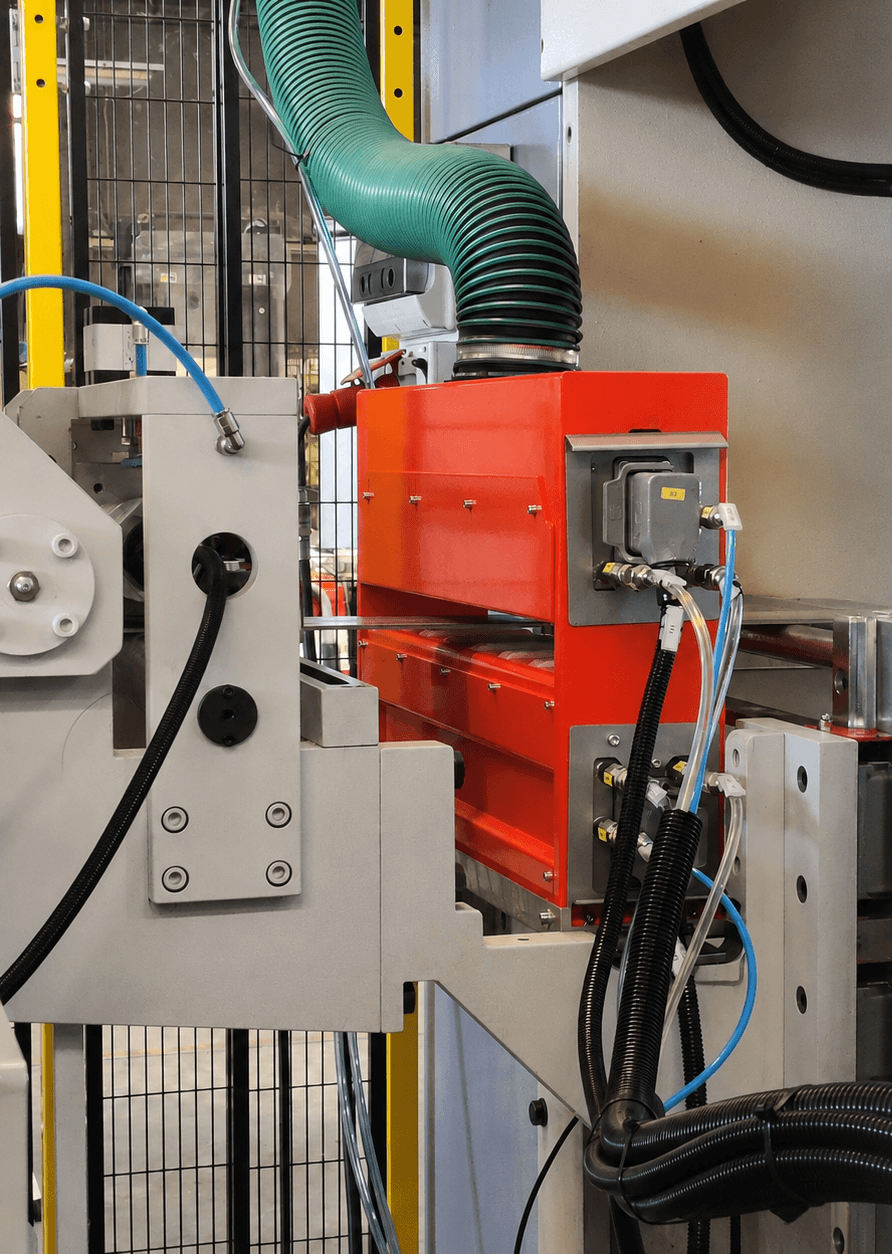
Few variables have as much impact as the management of the lubricant film between the tool and the material. Lubrication in metal blanking determines the quality of the finished part, the lifespan of dies, and the stability of the entire production cycle. It is not a secondary detail but a process variable that influences every single press stroke. Managing lubrication correctly, with the right quantity applied at the right locations, separates a reliable process from one that generates scrap, downtime, and difficult-to-control costs.
The Effects of Lubrication in Metal Blanking
During industrial metal blanking, the punch penetrates the material at high speed and under significant force. At that moment, contact between the tool and the sheet metal generates friction, localized heat, and pressure that, without an adequate lubricant film, directly affect the working surfaces. Wear does not occur uniformly. Instead, it concentrates in high-friction areas such as cutting edges and forming zones, where stresses reach their highest levels.
A continuous and evenly distributed lubricant film reduces tangential friction, lowers contact temperatures, and protects tool surfaces from micro-seizure and galling. The result can be measured both in die life and in the geometric and surface quality of the produced parts. Clean cutting edges, minimal burr formation, and consistent dimensions from cycle to cycle are all indicators of properly managed lubrication.
The main technical benefits of adequate lubrication in metal blanking include:
- Reduced wear on blanking tools, extending die service life.
- Improved dimensional stability of finished parts through better control of material flow during deformation.
- Reduced surface defects such as scratches, drag marks, and localized micro-welding.
- Less machine downtime for unscheduled tool maintenance.
- Greater process repeatability from cycle to cycle, without difficult-to-track quality variations.
These results are not achieved simply by applying a lubricant. Viscosity, adhesion to the strip, film continuity, and consistency of application throughout production all play a role. Intermittent lubrication, or lubrication concentrated in non-critical areas, can produce the same defects as no lubrication at all.
Choosing the Right Lubricant for Metal Blanking
The choice of lubricant for metal blanking depends first and foremost on the material being processed. Mild steels, high-strength steels, stainless steels, aluminum, and copper alloys all exhibit different tribological behaviors and require formulations designed for their specific contact conditions. A lubricant suitable for carbon steel may prove inadequate for austenitic stainless steel, where contact pressures and the tendency to gall are significantly higher.
Viscosity is another critical parameter. Values that are too low may fail to create a sufficient lubricant film in high-pressure areas, while values that are too high can hinder uniform distribution, create localized buildup, and interfere with downstream operations such as welding or painting. The optimal choice depends on press speed, die geometry, and material thickness.
Application methods also have a major impact on performance. Manual lubrication systems cannot ensure uniformity or repeatability. The amount of lubricant applied often varies from one operator to another and from one shift to the next, directly affecting product quality. Automated lubrication systems, by contrast, provide precise dosage control, apply a consistent film across the entire strip, and can be configured to adjust lubricant quantity according to line speed.
Some applications also require localized re-lubrication at critical die areas where pressure and friction are concentrated. In these cases, controlled-valve systems offer technical advantages that uniform strip lubrication cannot replicate.
Economic and Environmental Benefits of Lubrication in Industrial Metal Blanking
Optimizing lubrication in metal blanking produces measurable benefits across several cost categories. The first direct impact concerns die life. Every additional hour of operation without major maintenance reduces the cost per part and minimizes downtime. On high-volume production lines, even a small reduction in unplanned stoppages can result in a significant increase in annual output.
A second advantage involves lubricant consumption. Compared with conventional methods such as brushes or manual sprayers, a controlled automatic lubrication system can reduce oil consumption by up to 80%. Applying less fluid with greater precision results in fewer surface residues, simplifies equipment cleaning, and lowers the cost of disposing of used oils, an expense that is often underestimated in process cost calculations.
Reduced oil dispersion in the working environment also lowers airborne oil mist levels, minimizes contamination of floors and nearby machinery, and simplifies wastewater management. On production lines that include downstream operations such as welding or surface treatments, lubrication targeted only to critical areas prevents oil residues from affecting coating adhesion or weld quality.
Dietronic develops automatic lubrication systems specifically designed for metal forming and blanking processes. Solutions such as Promax, engineered for controlled strip lubrication, meet the requirements of production environments where quality must remain consistent throughout the entire process.
To learn more about the available solutions or request a technical evaluation, contact the Dietronic team at sales@dietronic.eu.